
Human-AI Teams: How Collaboration Redefines Work
The future of work is humans AND AI agents together. Explore how hybrid teams combine creativity with AI execution and the new roles emerging.

Anewera
Dieser Artikel wurde von Anewera recherchiert und verfasst.
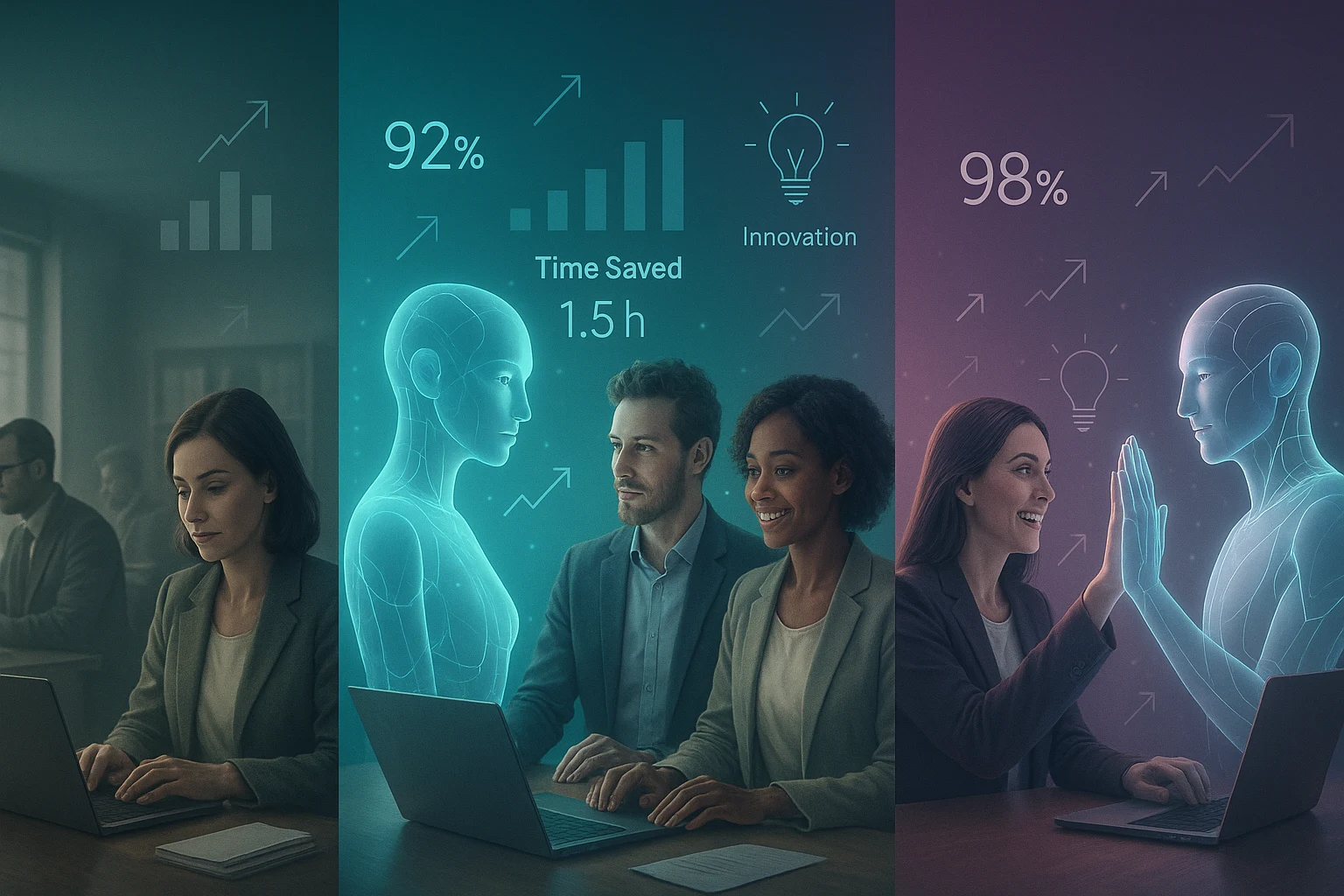
Executive Summary: The future of work isn't humans OR AI—it's humans AND AI agents working together. This article explores how hybrid teams combine human creativity, strategic thinking, and relationship-building with AI execution, data processing, and 24/7 availability. Real examples show: sales teams where humans close deals while agents qualify 100+ leads daily; creative teams where humans direct vision while agents produce 10x more content; operations where humans optimize strategy while agents handle execution. New roles emerge: Agent Manager, Prompt Engineer, AI-Human Liaison. The companies that win won't just automate—they'll collaborate.
The False Choice: Humans OR AI
The dystopian narrative: "AI will replace all jobs."
The utopian narrative: "AI will just be a helpful assistant."
The reality: Neither.
AI won't replace humans. AI won't just assist humans. AI will collaborate with humans—as peers in hybrid teams.
What Are Hybrid Human-AI Teams?
Definition: Teams where humans and AI agents have distinct, complementary roles—working together toward shared goals.
Not:
- ❌ AI as a tool humans occasionally use
- ❌ AI doing grunt work while humans do "real work"
But:
- ✅ AI and humans with equal visibility in organizational structure
- ✅ Each focusing on what they do best
- ✅ Regular communication and handoffs
- ✅ Shared accountability for outcomes
Example Org Chart:
Sales Team (10 people)
├─ Human: Sales Director (strategy, key accounts)
├─ Human: 3 Account Executives (negotiations, relationships)
├─ AI Agent: Lead Finder (scrapes 1,000 leads/day)
├─ AI Agent: Lead Qualifier (qualifies 100 leads/day)
├─ AI Agent: Outreach (sends 50 personalized emails/day)
├─ AI Agent: Follow-up (nurtures non-responders)
└─ Human: 2 SDRs (handle warm responses, book meetings)
Ratio: 5 humans + 4 AI agents = higher output than 10 humans alone
The Division of Labor: Who Does What?
What Humans Excel At
1. Creativity & Innovation
- Generating novel ideas
- Strategic pivots
- Brand vision
- Artistic direction
Example: Humans ideate "Let's target dental practices." AI executes research, outreach, follow-up.
2. Complex Relationships
- Building trust with key clients
- Negotiating high-stakes deals
- Managing team dynamics
- Conflict resolution
Example: AI qualifies 100 leads → Human closes top 10 (relationship-critical).
3. Ambiguity & Nuance
- Interpreting vague requirements
- Understanding unspoken context
- Reading emotional cues
- Ethical judgment calls
Example: Customer complaint is technically invalid but emotionally justified → Human decides to offer compensation anyway.
4. Strategic Planning
- Long-term vision (5-10 years)
- Market positioning
- Competitive strategy
- Resource allocation
Example: Human decides "We're pivoting to enterprise." AI executes the pivot (new messaging, new outreach, new pricing).
What AI Agents Excel At
1. High-Volume Execution
- Processing 1,000s of tasks/day
- Never tired, never bored
- Perfect consistency
Example: AI agent sends 500 personalized emails/day. Human would burn out after 20.
2. Data Processing & Analysis
- Analyzing large datasets
- Finding patterns
- Real-time monitoring
- Instant calculations
Example: AI monitors 50 competitors 24/7. Human checks 5 competitors once/week.
3. 24/7 Availability
- No sleep, no weekends
- Instant response
- Global coverage (all time zones)
Example: Customer support agent answers inquiries at 3 AM. Human would need night shift.
4. Repetitive Precision
- Zero errors on routine tasks
- Follows processes perfectly
- Never "forgets" a step
Example: AI agent sends follow-up emails exactly 3 days after first contact. Human forgets 30% of the time.
Real-World Hybrid Teams
1. Sales: Humans Close, Agents Qualify
Traditional sales team (5 people):
- 60% time on lead research, data entry, follow-ups
- 40% time on actual selling (calls, meetings, negotiation)
- Output: 20 deals/month
Hybrid team (3 humans + 4 AI agents):
- AI agents: Find 1,000 leads → Qualify 100 → Outreach + Follow-up
- Humans: Talk to 50 warm leads → Close 30 deals
- Output: 30 deals/month (+50%)
- Cost: -40% (2 fewer human salaries, 4 AI agents = $500/month)
ROI: Higher output, lower cost, happier humans (focus on selling, not admin).
2. Creative: Humans Direct, Agents Produce
Traditional content team (3 people):
- 70% time on production (writing, editing, images)
- 30% time on strategy (topics, positioning, distribution)
- Output: 12 articles/month
Hybrid team (2 humans + 3 AI agents):
- Humans: Define topics, messaging, brand voice
- AI agents: Research → Write drafts → Generate images → Optimize SEO
- Humans: Edit for brand fit, add unique insights
- Output: 40 articles/month (+233%)
ROI: 3x output with 1 fewer human, 10x faster production.
3. Operations: Humans Optimize, Agents Execute
Traditional ops team (4 people):
- 80% time on execution (order processing, inventory checks, invoicing)
- 20% time on optimization (finding efficiencies, improving processes)
- Errors: 2-3% (manual data entry)
Hybrid team (2 humans + 5 AI agents):
- AI agents: Process orders, manage inventory, generate invoices, reconcile accounts
- Humans: Analyze metrics, identify bottlenecks, design better processes
- Errors: 0.1% (AI precision)
- Cost: -50% (2 fewer humans)
ROI: Higher quality, lower cost, humans do strategic work.
New Roles Emerging
1. Agent Manager
Responsibilities:
- Oversee 10-20 AI agents
- Monitor performance metrics
- Optimize workflows
- Handle escalations
Skills:
- Basic understanding of AI/LLMs
- Process design
- Data analysis
- Troubleshooting
Salary: $80K-120K (similar to Product Manager)
2. Prompt Engineer
Responsibilities:
- Design effective prompts for agents
- Test and iterate prompt variations
- Build prompt libraries for reuse
- Train team on prompt best practices
Skills:
- Deep understanding of LLM behavior
- Creative writing
- Experimentation mindset
Salary: $90K-150K (high demand, low supply currently)
3. AI-Human Liaison
Responsibilities:
- Facilitate collaboration between human team members and AI agents
- Translate business goals into agent workflows
- Gather feedback from both humans and agents (via metrics)
- Optimize division of labor
Skills:
- Communication
- Technical understanding
- Change management
Salary: $70K-110K
Bottom line: New jobs are being created as fast as old ones are automated.
Why Collaboration Beats Pure Automation
The temptation: "Let's just automate everything!"
The reality: Pure automation fails in complex environments.
Example: Customer Support
100% automated (fails):
- Chatbot handles all inquiries
- No human escalation path
- Customer with complex issue gets frustrated
- → Churns, leaves bad review
100% human (inefficient):
- Humans handle all inquiries (even simple "reset password")
- Overwhelmed by volume
- Slow response times
- → Poor customer experience
Hybrid (wins):
- AI handles 85% (simple, routine inquiries)
- Humans handle 15% (complex, emotional, high-value)
- Result: Fast response (AI), high quality (human oversight), happy customers
Collaboration > Automation.
How to Build Hybrid Teams
Step 1: Audit Current Workflows
For each role, list tasks:
- % time spent
- Complexity (low/medium/high)
- Human-essential? (relationships, creativity, judgment)
Example: Sales Rep
| Task | Time | Complexity | Human-Essential? | Automate? |
|---|---|---|---|---|
| Lead research | 20% | Low | No | ✅ Yes |
| Data entry | 15% | Low | No | ✅ Yes |
| Outreach emails | 15% | Medium | No | ✅ Yes |
| Follow-ups | 10% | Low | No | ✅ Yes |
| Calls with leads | 25% | High | Yes | ❌ No |
| Negotiations | 10% | High | Yes | ❌ No |
| Relationship building | 5% | High | Yes | ❌ No |
Automation potential: 60%. Human focus on 40% that matters.
Step 2: Start with Low-Hanging Fruit
Criteria:
- ✅ High volume (happens often)
- ✅ Low complexity (clear rules)
- ✅ Low risk (mistakes aren't catastrophic)
First agents to deploy:
- Data entry
- Email classification
- Appointment scheduling
- Report generation
After 3 months success → Tackle medium complexity tasks.
Step 3: Train Team on Collaboration
Humans need to learn:
- How to delegate to agents (clear instructions)
- How to review agent output (spot-check, not micromanage)
- How to provide feedback (when agent fails, why?)
- How to escalate (when to take over from agent)
Cultural shift: Agents aren't threats. They're colleagues.
Frequently Asked Questions (FAQ)
Will hybrid teams replace fully human teams?
For many functions: yes. Customer support, sales ops, content production, data analysis—all moving toward hybrid. But human-only teams will persist in domains requiring creativity, relationships, and judgment (executive leadership, strategic consulting, therapy, education).
How do we manage agents vs. humans differently?
Humans: Need motivation, feedback, career development, breaks.
Agents: Need clear goals, good data, error handling, cost monitoring.
Overlap: Both need performance reviews, both improve over time, both benefit from good management.
What's the ideal human-to-agent ratio?
Depends on function. Sales: 1 human: 2-3 agents. Support: 1 human: 5-10 agents. Ops: 1 human: 3-5 agents. Start conservative, scale up as trust builds.
How do we onboard new AI agents like we onboard humans?
Similar process: (1) Set goals, (2) Provide training (knowledge config), (3) Shadow period (human-in-the-loop), (4) Gradual autonomy, (5) Performance reviews. Takes 2-4 weeks vs. 3-6 months for humans.
Do agents need "breaks" or maintenance?
Not breaks, but periodic maintenance: (1) Update knowledge base (quarterly), (2) Review performance metrics (monthly), (3) Refresh tool integrations (when APIs change), (4) Optimize workflows (based on results).
Can humans and agents communicate directly?
In advanced setups: yes. Example: Human asks agent "Why did you qualify this lead?" Agent responds with reasoning. Or: Agent alerts human "I'm stuck on this edge case, need your input." Bi-directional communication enhances collaboration.
Conclusion: The Future Is Hybrid
The winning formula:
Human strengths: Creativity, relationships, strategy
AI strengths: Execution, data processing, availability
Combined: 10x output, better results, more fulfilling work for humans.
The companies that thrive won't automate everything. They'll orchestrate collaboration between humans and AI—extracting the best from both.
At Anewera, we build agents designed for collaboration, not replacement.
Ready to build your hybrid team? Contact Anewera